Posts tonen met het label Assad. Alle posts tonen

dinsdag 2 augustus 2016

Amerika probeert weer een reden te creëren voor steun voor verdere bombardementen boven Syrië


http://www.nu.nl/buitenland/4301310/vaten-met-gifgas-boven-syrische-plaats-gedropt.html

De eerste keer dat dit is geprobeerd is ook gebleken dat de rebellen het gas hadden gebruik en niet de regeringstroepen. Zie onderstaande video van INFOWARS waarin de voorgaande gifgas aanval toevallig aanbod komt samen met andere huidige zaken die nu spelen.


donderdag 12 september 2013

Deconstructing The Syrian Banking System

Amid the daily turmoil in Syria, it comes as something of a surprise to see the financial statements of 12 of the country’s banks posted, quarter by quarter, on the website of the Damascus Securities Exchange (DSE).
By the end of May, all 12 had published audited financial statements for 2012, complete with detailed accounting notes.

But despite the apparent normality projected by the DSE’s website (daily changes in stock prices stream across the home page; weekly trading reports are easily available and up to date), echoes of the civil war can be detected.

In recent weeks, three banks have had trading in their shares suspended because they did not provide the Exchange with reports on their Annual General Assembly meetings – it is hardly surprising that convening an annual meeting, to be attended by numerous prominent directors and shareholders, is difficult to arrange when large gatherings present easy targets for bombs.
On 17 January, Bank Bemo Saudi Fransi informed the Exchange that it had transferred all funds in its Dair al-Zour branch to its head office in Damascus. (A few days later, rebel forces captured strategic positions around the city.) On 5 March the bank informed the Exchange that a convoy taking money to the Central Bank had been attacked by an armed gang, resulting in lost funds of S£25mn.
Amid the acres of news that have been published about the conflict in Syria, little has been written about how the conflict has affected the financial system. Economic reporting tends to focus on the exchange rate (which has depreciated by more than 100% since the start of the conflict) and the level of the Central Bank of Syria’s foreign exchange reserves (now probably down to around $2bn-3bn).

Banking Activity Has Declined DramaticallyCash, of course, is playing a much greater role in the economy than before. Banking activity is at a minimum as banks run down existing credit facilities while continuing to fund basic imports such as food and medicine. Banks say that they are able to get dollars as well as local currency to stock their ATMs (in areas under government control), although money exchangers are playing an increasingly important role in the distribution of cash.

Banks’ financial statements should give a reasonable impression of the broad trends in a country’s financial system. Those published in Syria – one of the least developed banking systems in the Middle East, even before the civil war – need to be treated with considerable care, although the figures published by subsidiaries of overseas banks are likely to be more reliable since overseas head offices are subject to supervision and auditing standards that are more robust than those applied in Syria.
With that caveat in mind, the financial statements of the 12 banks that report to the DSE show an aggregate 28% decline in loans extended in the two years to the end of 2012 and a 29% decline in customers’ deposits. In both cases the figures under-state the effective shrinkage in the banking system. Syrian banks report their financial results in Syrian pounds but have, at least in the past, extended some loans and taken some deposits in foreign currency.

A 50% devaluation in the Syrian pound will increase the reported value of a foreign currency loan by 50% on a bank’s local currency-denominated balance sheet. Without that effect, the banks’ loan portfolios would have shown a much greater decline.

As the crisis has deepened, banks have been converting foreign currency loans into local currency loans in the hope of improving their borrowers’ ability to repay. Again, the accounting treatment around such transactions has a big effect on the banks’ balance sheets, inflating the apparent size of their loan portfolios.
Well-placed observers comment that the assets and liabilities of the banking system have fallen dramatically since the end of 2012.

Syrian Banks’ Exposure To Key Foreign Banks Now MinimalThe decline of international lending and borrowing by Syrian banks can be seen in figures published by the Bank for International Settlements (BIS), an institution that tracks overseas exposures of banks in the major world economies. According to the BIS, banks in major economies had placed $264mn with banks in Syria (including the Central Bank) at the end of 2009. This figure halved by the end of 2010 and at the end of 2012 was down to $42mn. Placements by Syrian banks (including the Central Bank) with banks in the major economies stood at $16.31bn at the end of 2009, remained steady through 2010 before falling to $2.33bn at the end of 2012. The fall in placements by Syrian banks reflects both the repatriation and spending of much-needed foreign currency, as well as the redeployment of funds out of the major international banking systems and into others where the reach of international sanctions is less keenly felt.

The Syrian banking system was one of the smallest in the Middle East even before the civil war. Assets of $47.7bn at the end of 2010 represented 2.1% of the assets of commercial banks in the Arab Middle East. Private sector deposits of $23.5bn represented about 2.2%. This was a little more than Oman and Tunisia. Private sector credit was equivalent to 23% of Gross Domestic Product – a very low figure in a region where banks dominate financial intermediation.

Non-Performing Loans Double or TrebleIncome and net profit figures of the 12 listed banks have been fluctuating wildly as a result of revaluations of assets and as a result of loan loss provisioning. All 12 of the listed banks reported a doubling of non-performing loans (NPLs) in 2012 and in some cases a trebling or even quadrupling. Eight banks showed NPLs as more than 20% of their total loan portfolio.

Three of the 12 listed banks declared net losses for 2012, but income statements carry little meaning in the current Syrian environment. Quite apart from the exchange rate, which can turn revenue streams into losses, or vice versa, from one reporting period to another, the physical destruction of a client’s businesses can render loans which were performing yesterday uncollectable today.

(Although the exchange rate has depreciated considerably during the last two years, it is interesting to note that the unofficial rate shows big fluctuations and at times can show significant appreciation as well as depreciation. The collapse of a country’s exchange rate during a time of civil war cannot be assumed. For example, the Lebanese pound remained around $1=LL3 for the first seven years of the Lebanese civil war and only started to slide after the Israeli invasion of 1982, with the really big devaluations happening in the late 1980s and early 1990s. As any seasoned Lebanese banker will tell you, militias expect to be paid in cash, and usually in dollars, so civil wars bring a lot of foreign currency into a country, regardless of whether the official sector is running low on its own foreign reserves.)

The State-Owned Banks Dominate the Banking SystemThe 12 listed banks account for about a quarter of banking assets and liabilities in Syria. The state-owned banks dominate the system but their financial statements for recent years are not available.
The Central Bank of Syria’s public disclosure of aggregate banking statistics peters out in early 2011. Statistics for year-end 2010 show aggregated assets for the 20 banks at $47.7bn (converting the Central Bank’s Syrian pound figures into dollars at a rate of $1=S£45.79). State banks account for 71% of this. Note that not all private sector banks are listed on the DSE - Cham Bank and al-Baraka Syria are not.

Physical Safety and Hard Cash Crucial for Banking ActivityLooking ahead, the most obvious threats to the continuation of banking services in Syria are physical – the destruction of bank branches or security threats that prevent banks restocking their ATMs or prevent their staff from going to work. (In mid-June, the website of Arab Bank Syria announced that banking services had been discontinued at eight of its branches (out of 19), most of them in the south western corner of Syria, near the Lebanese border.)

The availability of physical cash in government-controlled areas will be another challenge for the banks. Much will depend on the willingness of the regime’s foreign backers to facilitate the printing of local-currency bank notes and the provision of foreign currency notes. (It is assumed that rebel-held areas will continue to receive cash dollars from their foreign benefactors.)

The state-owned banks will continue to support local industries, providing loans and not calling-in bad debts. They will be able to do this because the Central Bank of Syria will not enforce its own regulations. And because state-owned banks account for such a large part of the banking system, a significant part of the economy will be able to continue to operate as if all is well and everyone is paying everyone else on time. Again, it is when banking gets “physical” – for example, when wages have to be paid in cash, or foreigners paid in Dollars or Euros – that problems arise. If confidence in the regime declines, then, in regime- controlled areas, cash will become even more important than it is now.

*Andrew Cunningham has spent more than 25 years writing, training and consulting on banking and finance, both in the Middle East and in Europe and the U.S.

Darien Middle East advises clients on international financial regulation and best practices in risk management and corporate governance. The firm was founded in 2010 by Andrew Cunningham and is based in London. The firm publishes regular briefings on financial markets under the title, Darien Analytics.

woensdag 11 september 2013

Chemical attack was Syria rebel provocation, former hostages say

AFP Photo / Louai Abo Al-Jo

AFP Photo / Louai Abo Al-Jo
Two Europeans who were abducted and held hostage for several months in Syria claim they overheard an exchange between their captors which proves that rebels were behind the recent chemical attack.

In a number of interviews to European news outlets, the former hostages - Belgian teacher Pierre Piccinin and Italian journalist Domenico Quiric - said they overheard an English-language Skype conversation between their captors and other men which suggested it was rebel forces, not the government, that used chemical weapons on Syria’s civilian population in an August 21 attack near Damascus.

“It is a moral duty to say this. The government of Bashar al-Assad did not use sarin gas or other types of gas in the outskirts of Damascus,” Piccinin said during an interview with Belgium's RTL radio station.

Piccinin stressed that while being held captive, he and fellow prisoner Quirico were secluded from the outside world and had no idea that chemical weapons were deployed. But the conversation which both men overheard suggested that the use of the weapons was a strategic move by the opposition, aimed at getting the West to intervene.

"In this conversation, they said that the gas attack on two neighborhoods of Damascus was launched by the rebels as a provocation to lead the West to intervene militarily,”Quirico told Italy’s La Stampa. "We were unaware of everything that was going on during our detention in Syria, and therefore also with the gas attack in Damascus."
While stating that the rebels most likely exaggerated the accident’s death toll, the Italian journalist stressed that he could not vouch whether “the conversation was based on real facts." However, he said that one of the three people in the alleged conversation identified himself as a Free Syrian Army general, La Stampa reported.

Based on what both men have learned, Peccinin told RTL that it would be “insane and suicidal for the West to support these people.”

“It pains me to say it because I've been a fierce supporter of the Free Syrian Army in its rightful fight for democracy since 2012," Piccinin added.


Belgian national Pierre Piccinin (L) disembark from the airplane on September 9, 2013 at Ciampino military airport in Rome (AFP Photo)

Quirico seems to agree with Peccini’s assessment.
“I am extremely surprised that the United States could think about intervening, knowing very well how the Syrian revolution has become international jihadism – in other words Al-Qaeda," Quirico said, as quoted by Italy’s Quotidiano Nazionale.

The 62-year-old La Stampa journalist believes that radical Islamic groups operating in Syria to topple Assad “want to create a caliphate and extend it to the entire Middle East and North Africa.”

In a number of news appearances, both Quirico and Piccinin shared stories of how they were subjected to two mock executions, beaten, and starved during their five-month captivity.

"These have been very tough months. We were beaten on a daily basis, we suffered two mock executions," Quirico told reporters upon his arrival in Rome, AFP reported.


Italian journalist Domenico Quirico disembark from the airplane on September 9, 2013 at Ciampino military airport in Rome (AFP Photo)


"There was sometimes real violence...humiliation, bullying, mock executions...Domenico faced two mock executions, with a revolver," Piccinin told RTL.

Both men were kidnapped in Syria last April by a group of armed men in pickup trucks who were believed to be from Free Syrian Army.

According to Piccinin, the captors soon transferred them over to the Abu Ammar brigade, a rebel group "more bandit than Islamist."

"We were moved around a lot...it was not always the same group that held us, there were very violent groups, very anti-West and some anti-Christian," Piccinin said.

Both men tried to escape twice but their attempts were unsuccessful, prompting the rebel group to punish them for their actions.

The Italian government announced on Sunday that both men had been freed after Rome intensified negotiations with the rebels for the release of the prisoners ahead of an anticipated US strike on Syria.
Another 13 journalists are still believed to be missing in Syria, according to Reporters Without Borders.

Source: http://rt.com/news/chemical-weapons-rebels-captives-632/

maandag 9 september 2013

Syrians: NATO-backed Militants Seen Donning Gas Masks

Reports of Libyan chemical weapons brought in through Turkey, caches discovered in Damascus point to possible false flag.

by Tony Cartalucci

July 27, 2012 - For a Western media so fond of reporting "activist" accounts, rumors, and even fabrications, and with all the talk of an impending "massacre" in the northern Syrian city of Aleppo, reports of so-called "Free Syrian Army" militants seen trying on gas masks, along with reports of Libyan chemical weapon caches & equipment being discovered in Damascus is surely headline news.


Images: (Top) FSA fighters, one on the left wearing a "Jihadist" headband, another on the right trying on a military-grade gas mask, were reportedly photographed in Aleppo, Syria. (Bottom) Chemical weapons and equipment from Libya have been reportedly discovered as troops search areas of Damascus after quelling last week's militant attack.
....

Many Syrians and outside observers alike, fear that militants may deploy chemical weapons in one or more locations around Syria, creating a mass-casualty event to subsequently be blamed on the government by a coordinated Western media disinformation campaign. The so-called "Free Syrian Army" (FSA) has already been conducting strings of devastating, indiscriminate mass-casualty bombings across the country, as reported by Reuters', "Outgunned Syria rebels make shift to bombs."

Libyan weapons, cash, and fighters have also all been confirmed to have made it into Syria in an effort to undermine, divide and destroy Syria.

The London Telegraph reported in its article, "Libya’s new rulers offer weapons to Syrian rebels:"

"There is something being planned to send weapons and even Libyan fighters to Syria," said a Libyan source, speaking on condition of anonymity. "There is a military intervention on the way. Within a few weeks you will see."
The Telegraph has also learned that preliminary discussions about arms supplies took place when members of the Syrian National Council [SNC] – the country's main opposition movement – visited Libya earlier this month.
Albawaba reported in its article, "Libyan fighters join "free Syrian army" forces," that:

Libyan sources conveyed in recent days that 600 rebel fighters have already gone from Libya to Syria in order to support the Syrian opposition.
Albawaba's report would later be confirmed by multiple Western media representatives now on the ground in Aleppo, Syria, including CNN which reported:
Meanwhile, residents of the village where the Syrian Falcons were headquartered said there were fighters of several North African nationalities also serving with the brigade's ranks.
A volunteer Libyan fighter has also told CNN he intends to travel from Turkey to Syria within days to add a "platoon" of Libyan fighters to armed movement.
CNN also added:
On Wednesday, CNN’s crew met a Libyan fighter who had crossed into Syria from Turkey with four other Libyans. The fighter wore full camouflage and was carrying a Kalashnikov rifle. He said more Libyan fighters were on the way.

The foreign fighters, some of them are clearly drawn because they see this as … a jihad. So this is a magnet for jihadists who see this as a fight for Sunni Muslims.
Clearly Libyan terrorists and their weapons have made it into Syria with the explicit backing of NATO's recently installed client Libyan regime. The London Guardian had reported that Libya possessed some "25 metric tonnes of bulk mustard agent and 1,400 metric tonnes of precursor chemical used to make chemical weapons." The Guardian also reported:
The abandonment or disappearance of some Gaddafi-era weapons has prompted concerns that such firepower could erode regional security if it falls into the hands of Islamist militants or rebels active in north Africa.
Clearly those "Islamist militants" as well as "rebels active in north Africa" are now on the ground in Syria. These militants bringing pilfered chemical weapons with them is entirely plausible, as is the possibility that these weapons were purposefully placed into their hands by either NATO or Libya's current ruling regime. This very scenario was warned against last month in an article published by Russia Today titled, "Syrian rebels aim to use chemical weapons, blame Damascus – report."


Why Isn't the Western Media Investigating These Claims?

It should be remembered a single "tweet" from BBC's Ian Pannell in Aleppo claiming "fighter jets have bombed eastern Aleppo," triggered media hysteria. Pannell would expand on his earlier, unconfirmed, unsubstantiated claim by declaring, "what appeared to be Russian-made MiG planes arced through the sky. We watched as they dropped in, bombing and strafing rebel positions."

It would later turn out that the planes Pannell observed were not "MiG planes," where not "Russian-made," and were not even "bombing" rebel positions. They were trainer planes carrying out reconnaissance and at most, deploying gun-fire on rebel trucks mounted with heavy weapons.

Image: A sole"tweet" from BBC's Ian Pannell, now a confirmed fabrication, immediately made headlines across the Western media.
....
If one "tweet" is worth 3 news cycles, even when the report was both difficult to believe at face-value, and quickly turned out to be a fabrication - why isn't the Western media covering pictures and witness accounts of FSA militants apparently preparing to deploy chemical weapons inside and around Syria's major cities?
The answer is simple, reporting bombers that don't exist allowed the White House to claim, "the Syrian government's assault on the city of Aleppo with tanks and airplanes illustrates "the depth of depravity" by the regime of President Bashar Assad."
Similarly, by allowing claims of FSA militants preparing to deploy chemical weapons to go unreported, affords the West an opportunity to then blame the mass-casualty event that may follow on the Syrian government, thus providing an attractive opportunity for militarily intervene. That the media and governments of the West have not publicly looked into recent claims that the FSA is contemplating a false flag, weapons of mass destruction attack, makes them complicit should such an attack unfold. It will also make it all but impossible for the US to attempt to blame Libya and "Al Qaeda" alone if their dark deed is carried out, but subsequently exposed. 

vrijdag 6 september 2013

We have our plans if US launches war on Syria, Putin says

Russian President Vladimir Putin
 
Russian President Vladimir Putin says Moscow has its own plans to deal with a possible US military offensive against Syria.


Putin made the remarks on Tuesday night at his country residence outside Moscow during an interview with The Associated Press and Russia's state Channel 1 television published on Wednesday.

"We have our own ideas about what we would do and how we would do it if the situation develops toward the use of force or otherwise," he said. "We have our plans, but it's too early to talk about them."

The war rhetoric against Syria intensified after foreign-backed opposition forces accused the government of President Bashar al-Assad of launching a chemical attack on militant strongholds in the suburbs of Damascus on August 21.

Damascus has vehemently denied the accusations, saying the chemical attack was carried out by the militants themselves as a false-flag operation.

On August 31, US President Barack Obama said he has decided that Washington must take military action against the Syrian government, which would mean a unilateral military strike without a UN mandate.

Obama said that despite having made up his mind, he will take the case to US Congress. But he added that he is prepared to order military action against the Syrian government at any time.

The US president once again held the Syrian government responsible for the chemical weapons attack near Damascus.

On August 29, a meeting of the Security Council's permanent members ended without reaching an agreement on Syria.

The Western members of the council have been pushing for a resolution on the use of force while Russia and China are strongly opposed to any attack on Syria.

Since March 2011, Russia and China have vetoed three UN Security Council resolutions proposed by European states threatening military action and sanctions against Damascus.

The two countries are also opposing the current push by the United States and France to launch a war on Syria, vowing to veto any resolution that paves the way for the military action.

GJH/AS
 

donderdag 5 september 2013

De échte reden om Syrië aan te vallen

 
Geplande aardgaspijpleiding van Qatar naar Europa loopt door Syrië
 
aanleg pijpleidingQatar heeft gigantische aardgasreserves: 25 biljoen kubieke meter, ofwel 25 keer de hoeveelheid, die nu nog over is in de Nederlandse bodem. Afgelopen jaar produceerde het kleine Qatar 4,7% van de totale wereldproduktie. Het kost weinig moeite om het gas naar boven te halen, het is conventioneel aardgas, vergelijkbaar met het gas uit Slochteren.
Het Bruto Nationaal Produkt van Qatar bestaat voor 60% uit aardgasinkomsten. Qatar wil dolgraag de aardgasinkomsten verhogen, maar het transport van het gas naar de gebruikers in Europa is op het ogenblik de beperkende factor, de bottleneck.

Transport via LNG-tankers
Het aardgas uit Qatar wordt voor een groot deel verkocht als LNG, vloeibaar aardgas. In het afgelopen koude voorjaar raakte de gasvoorraad in Groot-Brittannië leeg. De Britten kochten vier tankerladingen LNG van Qatar om de voorraad aan te vullen.
Maar het transport via LNG-tankers is traag en duur. Het kost tijd en energie om het gas vloeibaar te maken. De ontvangende landen moeten een LNG-terminal bouwen met voldoende capaciteit. De schepen zijn traag en er is maar een beperkt aantal LNG-tankers (gigantische drijvende bommen) op de wereld.
Een gewone pijpleiding voor aardgas van Qatar naar Europa kan de transportcapaciteit verhogen.

De Nabucco-pijpleiding
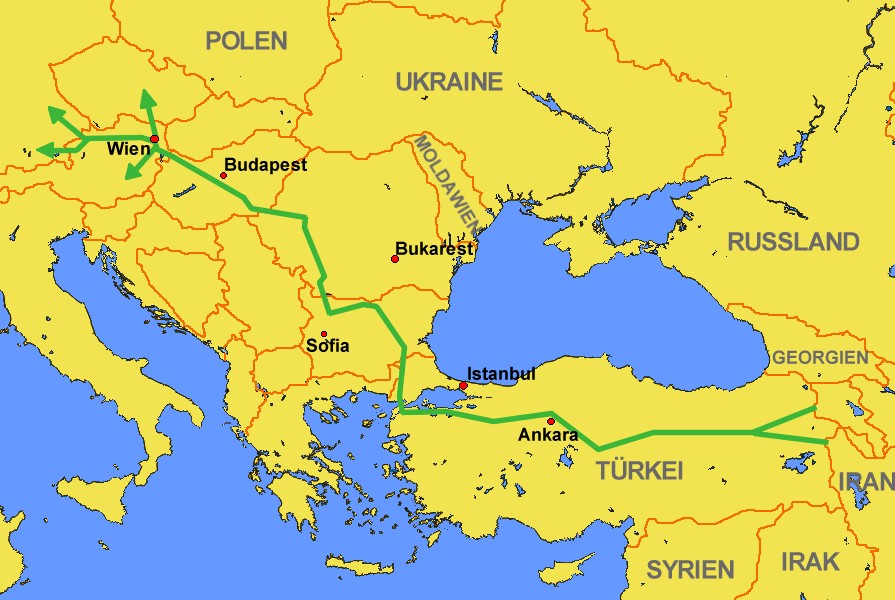
Er ligt al een pijpleiding voor aardgas van Turkije naar Europa, de Nabucco-pijpleiding.

nabucco2013
Nabucco pijpleiding

Oorspronkelijk was de Nabucco-pijpleiding bedoeld om aardgas uit Iran en Turkmenistan naar Europa te brengen. Maar Europa wil liever geen gas kopen van Iran. En Rusland heeft nog altijd een dikke vinger in de pap in Turkmenistan en belet het land om gas via de Nabucco-pijpleiding te leveren. De pijpleiding is bijna klaar, maar er kan nauwelijks gas gevonden worden om via de pijpleiding te vervoeren.

Een pijpleiding van Qatar naar Turkije via Syrië
De regering van Qatar wil graag aardgas verkopen en via de Nabucco-pijpleiding aan Europa leveren. En de Europese regeringen willen graag het gas van Qatar afnemen, om zo minder afhankelijk te worden van Gazprom en Poetin.

Daarom zou het prachtig zijn als er een pijpleiding van Qatar via Saoedi-Arabië, Jordanië en Syrië naar Turkije (een afstand van 2000 km.) zou worden aangelegd.

De burgeroorlog in Syrië draait niet alleen om de aanleg van een gaspijpleiding die Qatar aansluit op de Nabucco-pijpleiding. Maar er zijn wel partijen, die er groot (financieel) belang bij hebben dat de burgeroorlog snel is afgelopen.

Het steenrijke Qatar steunt de Syrische rebellen en levert wapens en hoopt op die manier de aanleg van een pijpleiding te bespoedigen.

Europa wil niet dat een onvoorspelbare dictator als Assad de toevoer van goedkoop, niet-Russisch aardgas nog jarenlang kan blokkeren. Ook Europa is erbij gebaat als de pijpleiding er snel komt en goed bewaakt wordt.

qatarturkije
Geplande pijpleiding over Syrisch grondgebied

Bij de oorlog in Afghanistan speelde op de achtergrond de aanleg van de TAPI-gaspijpleiding van Turkmenistan naar Pakistan mee.

Ook bij de burgeroorlog in Syrië is de aanleg van een gaspijpleiding mogelijk een reden voor buitenlandse inmenging. En ook over deze pijpleiding zul je maar weinig horen van politici en journalisten.

Bron: Cassandraclub.com

Mijn bron: http://www.gewoon-nieuws.nl/2013/09/de-echte-reden-om-syrie-aan-te-vallen/

Syrië en Iran: Probleem voor Centrale Bankiers


De enige twee Arabische naties met ‘eigen’ centrale banken: Iran en Syrië..

Het is geen groot nieuws als we je vertellen dat de hele Westerse wereld nog maar één haar verwijderd is van een totaal bankroet.. Waarbij er nog maar twee centrale banken werkzaam zijn, die géén rode cijfers laten zien. De Amerikaanse staat Noord Dakota en het land Zuid Afrika. Het is ook een algemeen gegeven, dat ‘alleen een oorlog’ er weer voor kan zorgen, dat we met een blanco lei beginnen.. Een centrale bank van een land, geeft de valuta van dat land uit, in chartaal (munten en biljetten) en giraal (‘digitaal’ geld) geld. Maar die centrale bank bepaalt ook de rentevoet en houdt de geldvoorraad in de gaten, zodat de economie niet vastloopt..
 
Geld is immers het bloed van de economie en dat geldt niet alleen op nationaal niveau, maar vanzelfsprekend ook op wereldniveau. Geld is een betaalmiddel, maar de laatste 50 jaar is het steeds meer een doel op zich geworden. Het geld dient feitelijk als ‘handig’ ruilmiddel, dat het eenvoudig maakt om goederen te produceren en consumeren. De nationale economie én de nationale overheden, draaien feitelijk op het geld van de centrale bank. Elke rente die als prijs-voor-geld wordt betaald, door overheid en bedrijven, wordt door de nationale belastingdiensten geïnd. Dit geld komt ten goede van het volk en haar welvaart. Dát is althans hoe het zou moeten gaan..
 
printing money
 
Een centrale bank is ook in staat, door haar feitelijke monopoly op haar specifieke munt-eenheid, om staatobligaties, staatsleningen uit te schrijven en ander schatkistpapier. Dit is niet ‘zomaar’ een truck van de centrale bank, want deze moet feitelijk voor dit waardepapier onderpand hebben.. En dat mogen sinds een aantal jaren ook ‘schulden-van-anderen’ zijn, zoals hypotheekpakketten bijvoorbeeld. En deze pakketten zijn een steeds groter onderdeel van de ‘nationale schuld’ geworden.
Hypotheken zijn feitelijk gedekt door -over het algemeen- onroerend goed en hebben een looptijd van 20 tot 30 jaar. Investeerders zijn over het algemeen bereid hypotheekpakketten als onderpand te nemen voor het uitlenen van hun geld. Derivaatpakketten zijn feitelijk vaak pakketten met 10.000-den onderliggende hypotheken, aan elkaar gekoppeld door financieel-economische voorwaarden. Slechts gedekt door de onderliggende onroerend-goed-portefeuilles.
 
Internationaal..
Zoals je weet heeft het Internationale Monetaire Fonds de macht om toe te zien op elk land. En die ziet toe op de financiële stromen in de wereldeconomie en het IMF heeft al jaren geleden haar toestemming gegeven voor het verhandelen van deze hypotheekpakketten, feitelijk dus onderpand-op-onroerend-goed. Steeds vaker blijkt echter dat een nationale valuta bestaat uit pure ‘lucht’.. Dat heet met een chique woord ‘monetaire financiering’.
 
Feitelijk komt het erop neer, dat een land gewoon de geldpers laat draaien, zónder dat er een degelijk onderpand tegenover staat. Onze geldmarkt, wereldwijd, is eigenlijk een holle doos geworden.. Kijk bijvoorbeeld naar de idiotie, die plaatsvond, nádat de Amerikanen Irak hadden ingelijfd..Pallets met monetair bloed’ dienden naar Irak te komen, om het bestaande geld voorlopig te vervangen.. Een nieuw land dat weer behoefte had aan de valuta van de overwinnaar..
 
Er staat dus geen onderpand meer tegenover geld.. Behalve.. Wanneer er weer wél landen zijn, of nóg landen zijn, die het goed voor elkaar hebben, en een positieve betalingsbalans hebben. Dat wil zeggen, dat ze feitelijk dus een overschot hebben. Centjes op de bank..
 
Wanneer nu een land dat in de problemen zit of komt, keihard moet gaan lenen, bijvoorbeeld ‘bij de buren’, dan begint het internationale spel van ‘wie-heeft-er-nog-onderpand’… Nou, en daar begint dus feitelijk dit verhaal.. Daar waar goud vroeger de officiële standaard was voor een centrale bank, op basis waarvan deze geld mocht drukken, daar zijn er nog maar heel weinig landen die niet bij de buren hoeven lenen en zelf hun broek kunnen ophouden. Omdat ze dus ‘onderpand’ genoeg hebben en niet hoeven lenen.. De vraag die onder dit verhaal ligt, is natuurlijk: “Wie is uiteindelijk de grote leenheer”.. “Wie krijgt de rente van al die schulden in handen?” en “Wie heeft al deze leningen ‘uitstaan’”..?
 
bernanke3
 
Het resultaat van de krappe geldmarkt en de enorme vraag naar (gezond) geld, is dat er -ondanks al het bijdrukken zonder onderpand- toch telkens gekeken wordt naar een ‘onderpand’ voor het gedrukte of uitgeleende geld.. Dat sommige landen/staten nog steeds in zwarte cijfers zitten, betekent vanzelfsprekend dat ze niet alleen hun uitgaven goed in de hand hebben, maar ook genoeg inkomsten hebben, en daaruit afgeleid, genoeg onderpand voor een gezonde betalingsbalans..
 
Wat er in de wereld is gebeurd, is dat er telkens economieën over de kop gingen en die waren vooral op schuld-gebaseerd.. ‘Leen-maar-raak’ was daarbij het credo, maar elke boerenjongen kan begrijpen, dat dit niet eindeloos door kan gaan. Faillissement dus.. En natuurlijk probeert het IMF op haar beurt weer die schulden in een groot ‘schuldenzwembad’ te storten, waarvan het IMF garandeert dat het wordt betaald, maar ook het IMF is niet van eindeloos uitrekkend elastiek. Het IMF moet ook aan basisvoorwaarden voldoen en doet dit officieel ook.. Wanneer een economie van een land of staat stopt met groeien, dan is vaak een faillissement nabij. De leningen kunnen niet meer worden voldaan door (over-)consumptie..
 
Want je kunt natuurlijk moeilijk méér geld voor dezelfde producten gaan vragen (en krijgen!) van hetzelfde aantal mensen, als je niet de prijzen gaat verhogen. Vervolgens gaat de werknemer naar zijn baas en vraagt om meer geld, omdat de prijzen zijn gestegen. Die berekent het weer door in de prijzen en zo zitten we in een spiraal naar het einde; de inflatiespiraal is gestart.
 
Wanneer je ziet hoe de oud-officier van justitie en goeverneur van New York, Eliot Spitzer, door de regering Bush werd behandeld, simpel omdat hij de malversaties van de centrale (NY) overheid aan durfde pakken, dan zal je veel duidelijk worden. De overheden fraudeerden op grote schaal mee, om het spel van geld drukken en uitgeven-wat-je-niet-hebt te spelen. Het waren in die tijd vooral de onroerend-goed-pakketten die solide leken, maar feitelijk zo lek als een mandje waren.. De emmer gaat zo vaak te water tot hij zinkt. En zoals je weet, getuige de bankencrisis van 2008, gezónken is die..
 
Ná het voeren van oorlogen, waarbij de spaargelden van bedrijven en particulieren zijn geplunderd om de oorlog te financieren, kan het spel weer opnieuw beginnen. Gedecimeerde bevolking en opbouwbehoefte, maken een ‘nieuwe start’ mogelijk. Maar in ons huidige tijdsbeeld is het niet meer mogelijk om dit spel te spelen, zónder dat dit heftig in de gaten loopt. Oorlogen zijn niet meer van deze tijd. Of… Deze generatie dient elke oorlog te voorkomen en depressie te bestrijden, het spel van verwoesting-en-opbouw niet meer te ‘spelen’..!
 
ghadaffi
 
Over een dictator die opstond en té groot werd.
Integenstelling tot wat weinig mensen weten, is dat Mohammed Ghadaffi, de vermoordde leider van Libië, dit spel tot in de finesses begreep. Hij wist dat het geldimperium in de wereld wordt bestuurd door een ‘happy few’, waarbij de naam van de Rothschild-familie als eerste en voornaamste vaak valt. Terecht valt. En dat de macht van deze club zó groot is, dat er wordt gesproken over een vermogen van vele honderden triljoenen Euro’s, kun je je bijna niet voorstellen.. Een van de echtgenotes van de familie liet op een feest eens uit haar mond glijden, dat als ‘mijn man wil dat er ergens in de wereld een oorlog begint, dat die dan gaat plaatsvinden’…
 
In dit kader zijn de speculaties (bewijzen zijn er immers nauwelijks te vergaren!), dat het ‘rijk’ van Moammar Gadhaffi door de NATO kapot werd geschoten, juist omdat hij zijn eigen munt wilde maken, waarschijnlijk op waarheid gebaseerd.
 
dollarbill-gold-value1
 
Lees verder op: WantToKnow.nl
 

Russia releases key findings on chemical attack near Aleppo indicating similarity with rebel-made weapons

People injured in what the government said was a chemical weapons attack, breathe through oxygen masks as they are treated at a hospital in the Syrian city of Aleppo March 19, 2013 (Reuters / George Ourfalian)

People injured in what the government said was a chemical weapons attack, breathe through oxygen masks as they are treated at a hospital in the Syrian city of Aleppo March 19, 2013 (Reuters / George
Probes from Khan al-Assal show chemicals used in the March 19 attack did not belong to standard Syrian army ammunition, and that the shell carrying the substance was similar to those made by a rebel fighter group, the Russian Foreign Ministry stated.

A statement released by the ministry on Wednesday particularly drew attention to the “massive stove-piping of various information aimed at placing the responsibility for the alleged chemical weapons use in Syria on Damascus, even though the results of the UN investigation have not yet been revealed.”

By such means “the way is being paved for military action”against Damascus, the ministry pointed out.

But the samples taken at the site of the March 19 attack and analyzed by Russian experts indicate that a projectile carrying the deadly nerve agent sarin was most likely fired at Khan al-Assal by the rebels, the ministry statement suggests, outlining the 100-page report handed over to the UN by Russia.
The key points of the report have been given as follows:

• the shell used in the incident “does not belong to the standard ammunition of the Syrian army and was crudely according to type and parameters of the rocket-propelled unguided missiles manufactured in the north of Syria by the so-called Bashair al-Nasr brigade”;

• RDX, which is also known as hexogen or cyclonite, was used as the bursting charge for the shell, and it is “not used in standard chemical munitions”;

• soil and shell samples contain “the non-industrially synthesized nerve agent sarin and diisopropylfluorophosphate,” which was “used by Western states for producing chemical weapons during World War II.”
The findings of the report are “extremely specific,” as they mostly consist of scientific and technical data from probes’ analysis, the ministry stressed, adding that this data can “substantially aid” the UN investigation of the incident.

While focusing on the Khan al-Assal attack on March 19, in which at least 26 civilians and Syrian army soldiers were killed, and 86 more were injured, the Russian Foreign Ministry also criticized the “flawed selective approach” of certain states in reporting the recent incidents of alleged chemical weapons use in August.

The hype around the alleged attack on the eastern Damascus suburb of Ghouta showed “apparent attempts to cast a veil over the incidents of gas poisoning of Syrian army soldiers on August 22, 24 and 25,” the ministry said, adding that all the respective evidence was handed to the UN by Syria.
The condition of the soldiers who, according to Damascus, suffered poisoning after discovering tanks with traces of sarin, has been examined and documented by the UN inspectors, the ministry pointed out, adding that “any objective investigation of the August 21 incident in eastern Ghouta is impossible without the consideration of all these facts.”

UN Secretary General Ban Ki-moon on Tuesday said the UN investigators are set to return to Syria to investigate several other cases of alleged chemical weapons use, including the March 19 incident in Khan al-Assal.

Source: http://rt.com/news/chemical-aleppo-findings-russia-417/