
Posts tonen met het label NASA. Alle posts tonen
Posts tonen met het label NASA. Alle posts tonen
donderdag 23 februari 2017

woensdag 6 mei 2015


vrijdag 3 april 2015
zondag 25 mei 2014
Ancient Bowl On Mars Found By Curiosity Rover, May 2014, UFO Sighting News.

Date of discovery: May 2014
Location of discovery: Mars
Email Report: Found by R.G.
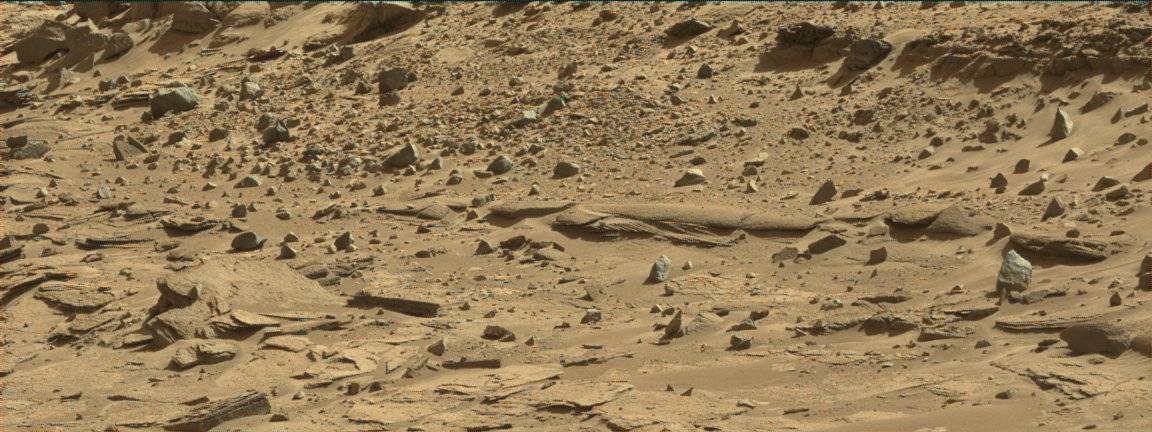
Photo: Sol 529
This came in the email this week. A reader found a few anomalies in this photo and brought it to my attention. This object looks like a bowl. There is a crack down one side and it has some sand or dirt that has filled it part of the bottom.
Its a really cool discovery and not something that NASA would ever investigate with the Curiosity Rover. The public really has to find a way to take control of the rover away from NASA and put it into public hands. Since it was funded with public dollars...that might not be so hard to do. SCW


Source: http://www.ufosightingsdaily.com/2014/05/ancient-bowl-on-mars-found-by-curiosity.html
dinsdag 1 april 2014
Fossil On Mars Points To Ancient Ocean With Life, March 31, 2014, UFO Sighting News.
Date of discovery: March 31, 2014
Location of discovery: Mars
As the rover was taking photos, it indadvertedly recorded ancient aliens sea life. I'm sure NASA would have covered it up had they seen it, but this does confirm there there was water on Mars. For some reason, NASA is saving this information for when they need it...maybe a push to save NASA or a push for larger budgets.
 Several things we know to be true about this photo. 1st this is a fossil. 2nd this was taken by the Mars rover. 3rd the photo was put on the JPL site by NASA. What this means is NASA cannot dispute this claim nor will they ever try. NASA will not turn the rover around to reexamine this fossil, nor do they care...since they already have an abundance of Top Secret images that expose alien life on Mars.
I have posted a similar sea shell that I found back in March 2012.Check it out here.
I have a similar ammonite fossil on my desk right now as I type this. Its an ancient water animal, a kind of Mollusc. On Earth most these style of molluscs are 200-400 million years old, but on Mars...who knows? SCW

Source: http://www.ufosightingsdaily.com/2014/04/fossil-on-mars-points-to-ancient-ocean.html
zondag 23 februari 2014
NASA Images Find 1.7 Million Year Old Man-Made Bridge
The NASA Shuttle has imaged a mysterious ancient bridge between India and Sri Lanka. The bridge was purportedly passable on foot until 1480 AD when a cyclone moved the sand around.

This recently-discovered bridge has been found to be made of a chain of limestone shoals. Its unique curvature and composition by age reveals that it is man made. The bridge currently named as Adam’s Bridge (most popularly known as Ram Setu) is about 18 miles (30 km) long.
This bridge starts as chain of shoals from the Dhanushkodi tip of India’s Pamban Island and ends at Sri Lanka’s Mannar Island. Water between India and Sri Lanka is only 3 to 30 feet (1 to 10 meter) deep. Owing to shallow waters, this bridge presents a problem in navigation as big ships cannot travel in the shallow waters of the Pamban channel.
This information is a crucial aspect for an insight into the mysterious legend called Ramayana, which was supposed to have taken place in tredha yuga (more than 1,700,000 years ago).
 In this epic, there is a mentioning about a bridge, which was built between Rameshwaram (India) and Srilankan coast under the supervision of a dynamic and invincible figure called Rama who is supposed to be the incarnation of the supreme.
This information may not be of much importance to the archeologists who are interested in exploring the origins of man, but it is sure to the spiritual gates of the people of the world to have come to know an ancient history linked to the Indian mythology.
Credits: Rense via Altering Perspectives
Source: http://www.whydontyoutrythis.com/2014/01/nasa-images-find-1-7-million-year-old-man-made-bridge.html?m=1
donderdag 6 februari 2014
I was just looking through the latest NASA photograph from the Mars Rover and saw an image which seems to depict a head of a statue buried in the sand. Have a look for yourself and see what I mean.
Go to the Nasa photo here: http://www.nasa.gov/sites/default/files ... 528-wb.jpg
The go to the right hand side of the image, about half way down from the top. Go into close up and you can see it for yourself.
You can see it here, where I have isolated it and put it up as a separate graphic:

I'm not claiming it is a statue of course, but it does look very real...
Read more: http://www.disclose.tv/forum/head-of-a-statue-in-latest-nasa-mars-rover-image-t91050.html#ixzz2sWuc0Zcg
http://www.disclose.tv/forum/head-of-a-statue-in-latest-nasa-mars-rover-image-t91050.html
Go to the Nasa photo here: http://www.nasa.gov/sites/default/files ... 528-wb.jpg
The go to the right hand side of the image, about half way down from the top. Go into close up and you can see it for yourself.
You can see it here, where I have isolated it and put it up as a separate graphic:
I'm not claiming it is a statue of course, but it does look very real...
Read more: http://www.disclose.tv/forum/head-of-a-statue-in-latest-nasa-mars-rover-image-t91050.html#ixzz2sWuc0Zcg
http://www.disclose.tv/forum/head-of-a-statue-in-latest-nasa-mars-rover-image-t91050.html
maandag 20 januari 2014
Nasa plan for a second sun?!
Will the Cassini Space probe be used as a nuclear trigger to ignite Saturn and terraform its moons for human colonization?

A paper titled "The Lucifer Project" has recently emerged which claims that NASA is very likely to deliberately direct the Cassini space probe into Saturn's dense atmosphere where it will destruct.
The paper's author contends this will be a secret effort to use the Cassini's plutonium fuel rods as a fission device to generate a runaway nuclear fusion process on Saturn, that would trigger the emergence of a new sun.
The new sun would enable the moons of Saturn to be heated, possibly making them suitable for colonization and other uses by humanity.
On the other hand, the creation of a new sun would generate a shock wave of hydrogen and other particles that could have devastating effects on Earth.
In order to fully evaluate the radical views presented in "The Lucifer Project" it is best to begin with Richard Hoagland's analysis of the Galileo space probe's controlled descent into Jupiter's equatorial region in 2003, where it was destroyed in a similar manner to what is projected for Cassini.
Did NASA Accidentally "Nuke" Jupiter? - http://www.enterprisemission.com/NukingJupiter.html
The Lucifer Project - http://www.bibliotecapleyades.net/ciencia/ciencia_luciferproject01.htm
The William Cooper Files - http://www.bibliotecapleyades.net/esp_sociopol_cooper.htm
Could NASA Use Galileo to Create a Jovian Nagasaki? - http://yowusa.com/space/2003/space-2003-09a/1.shtml
Galileo Spacecraft to be crashed into Jupiter to Safeguard Europa and Io - http://www.spaceref.com/news/viewnews.html?id=175
"The Lucifer Project" - NASA's Secret Plan to Create a Second Sun in Our Solar System? - http://www.youtube.com/watch?v=7uQ4-Jn77xI&feature=youtu.be
Source: http://beforeitsnews.com/beyond-science/2014/01/is-this-the-face-of-the-king-of-atlantis-2445092.html

A paper titled "The Lucifer Project" has recently emerged which claims that NASA is very likely to deliberately direct the Cassini space probe into Saturn's dense atmosphere where it will destruct.
The paper's author contends this will be a secret effort to use the Cassini's plutonium fuel rods as a fission device to generate a runaway nuclear fusion process on Saturn, that would trigger the emergence of a new sun.
The new sun would enable the moons of Saturn to be heated, possibly making them suitable for colonization and other uses by humanity.
On the other hand, the creation of a new sun would generate a shock wave of hydrogen and other particles that could have devastating effects on Earth.
In order to fully evaluate the radical views presented in "The Lucifer Project" it is best to begin with Richard Hoagland's analysis of the Galileo space probe's controlled descent into Jupiter's equatorial region in 2003, where it was destroyed in a similar manner to what is projected for Cassini.
Did NASA Accidentally "Nuke" Jupiter? - http://www.enterprisemission.com/NukingJupiter.html
The Lucifer Project - http://www.bibliotecapleyades.net/ciencia/ciencia_luciferproject01.htm
The William Cooper Files - http://www.bibliotecapleyades.net/esp_sociopol_cooper.htm
Could NASA Use Galileo to Create a Jovian Nagasaki? - http://yowusa.com/space/2003/space-2003-09a/1.shtml
Galileo Spacecraft to be crashed into Jupiter to Safeguard Europa and Io - http://www.spaceref.com/news/viewnews.html?id=175
"The Lucifer Project" - NASA's Secret Plan to Create a Second Sun in Our Solar System? - http://www.youtube.com/watch?v=7uQ4-Jn77xI&feature=youtu.be
Source: http://beforeitsnews.com/beyond-science/2014/01/is-this-the-face-of-the-king-of-atlantis-2445092.html
maandag 30 december 2013
Is the Moon Man-Made? (also read the comments!)
Is the moon hollow? Was it man-made, with a thick layer of dust simply covering its metal frame over billions of years?
 Of course, this supposes that advanced human civilizations existed billions of years ago, a theory which has also gained some attention as artifacts are found that call into question the conventional understanding of history. (See Epoch Times special topic Reconsidering History)
Such theories remain of interest to many as scientists continue to study the moon and learn about its composition and workings.
Here’s a look at some moon oddities.
1. Reverberations: Hollow Moon?
NASA created an impact on the moon in 1969 so Apollo 12 astronauts could measure the resulting seismic waves. The shock waves shocked scientists.
Very different from any seismic phenomena recorded on Earth, the vibrations continued for about an hour and started out as small waves that gained in strength.
Dr. Ross Taylor’s explanation is quoted in the Apollo Lunar Surface Journal on the NASA website. Taylor is a lunar scientist who helped examine samples gathered by Apollo 11.
He said: “This was one of those extraordinary things. When you had the impact of these things on the moon, unlike a terrestrial earthquake, which dies away quickly, the shock waves continued to reverberate around the moon for a period of an hour or more, and this is attributed to the extremely dry nature of the lunar rock.
“As far as we know there is no moisture on the moon, nothing to damp out these vibrations. The moon’s surface is covered with rubble and this just transmits these waves without them being damped out in any way as they are on Earth. Basically, it’s a consequence of the moon being extremely dry.”
Suniti Karunatillake, an astronomer at Stonybrook University, wrote on the “Ask an Astronomer” website that if the moon were hollow, due to its size, it could not be dense enough to have the gravitational force it does.
2. Anomalous Orbit

Italian physicist Lorenzo Iorio published an article in the Monthly Notices of the Royal Astronomical Society in 2011 discussing the “anomalous behavior” of the moon.
He said a slight change over time in the lunar orbit could not be explained within the current paradigm. The moon’s orbit is increasing in eccentricity.
Eccentricity is a measure that describes how much an orbit deviates from a perfect circle.
Iorio concludes in the study abstract, “The issue of finding a … [satisfactory] explanation for the anomalous behavior of the moon’s eccentricity remains open.”
3. Convex Moon Craters

Webb crater (NASA)
Some craters on the moon are convex (with a surface that is curved or rounded outward) instead of concave (curved inward, or hollowed), which some say is evidence of a rigid (man-made) shell below the surface layer. When meteors hit the moon, one would expect them to make concave craters.
Charles A. Wood, of the Department of Geological Sciences at Brown University, wrote in a 1978 paper that these convex craters were likely created by lava. He said the lava seeped up through fractures to the surface.
He noted: “For the lava to form rings rather than ponds … requires a higher viscosity or a lower extrusion rate than normal mare lavas [“Mare” refers to large, dark plains on the moon formed by volcanic eruptions once thought to be seas]. The magma may have been mare basalts erupted under unusual conditions, or mare basalt that differentiated within pockets, or in some cases, a non-mare magma type.”
4. Moon Stabilizes the Earth’s Axis
Whether intentionally made to serve some function or not, the moon provides a service to the Earth.
“The moon stabilizes Earth’s wobble, which has led to more stable climate,” according to NASA.
NASA scientist Dr. Eric Christian and NASA education outreach specialist Beth Barbier explain more in post on NASA’s website: “[The moon adds] drag to the Earth’s rotation in the form of tides, both oceanic and internal. This added drag tends to stabilize the rotation. It is also gradually slowing down the rotation of the Earth, which gradually lengthens Earth days.”
5. Size Coincidences

The same numbers come up in looking at measurements related to the moon, sun, and Earth. The diameter of the sun is about 400 times the diameter of the moon; the moon is also about 400 times closer to Earth than the sun.
The diameter of the sun is about 108 times the diameter of the Earth; the distance between the Earth and the sun is about 108 times the diameter of the sun.
Moon diameter: 2,100 miles (3,400 kilometers)
Sun diameter: 864,000 miles (1,391,000 kilometers)
Earth diameter: 7,900 miles (12,756 kilometers)
Distance from moon to Earth: 225,700 miles (360,000 kilometers)
Mean distance from sun to Earth (it is sometimes closer, sometimes further): 92,900,000 miles (149,600,000 kilometers)
Sun diameter: 864,000 miles (1,391,000 kilometers)
Earth diameter: 7,900 miles (12,756 kilometers)
Distance from moon to Earth: 225,700 miles (360,000 kilometers)
Mean distance from sun to Earth (it is sometimes closer, sometimes further): 92,900,000 miles (149,600,000 kilometers)
MORE:
Read more: http://www.theepochtimes.com/n3/404345-is-the-moon-man-made/#ixzz2oIQk6xbV
Source: http://www.theepochtimes.com/n3/404345-is-the-moon-man-made/
dinsdag 12 november 2013
Green Jelly Fish UFO In Earths Orbit Found In NASA Archive Photo, Nov 2013, -video- UFO Sighting News.

Date of discovery: November 2013
Location of discovery: Earths Orbit
Throughout UFO history, jellyfish UFOs with long moving tentacles have been recorded and reported around the world. This is a great example of such a UFO. Notice the beam of light coming down towards earth from the tentacle and also notice that there seems to be a wide stream behind the UFO from which it came. With thousands...yes I said that correctly, thousands of UFOs and structures being found in old NASA photos, how can they still deny the existence of aliens? You know why...because they have an agenda to hide alien existence. SCW
vrijdag 8 november 2013
GIANT ALIENS PILOT SATURN SPACE SHIPS
Dr. Norman Bergrun is an alumnus of Ames Research Laboratory, NACA (National Advisory Committee for Aeronautics) predecessor of Ames Research Center, NASA where he worked twelve years as a research scientist.
At Ames, he pioneered the setting of design criteria for airplane thermal ice-prevention and the developing of roll stability laws for airplanes, missiles and rockets.
He joined Lockheed Missiles and Space Company (now Lockheed Martin) where he was manager of the planning and analysis of flight tests for the Navy Polaris Underwater Launch Missile System.
During his thirteen years at Lockheed, he also served as a senior scientist having responsible analysis cognizance of special space-satellite applications.
Dr. Bergrun privately undertook a detailed study of the NASA Voyager 1 and Voyager 2 photographs of the rings of Saturn.
He has discovered how the rings are being formed by emissions emerging from gigantic electromagnetic vehicles (EMV’s), controlled by 7ft dark skinned Extraterretrials.


Source: http://theviralpost.com/giant-aliens-pilot-saturn-space-ships/
woensdag 16 oktober 2013
Greenwald on Snowden Leaks: The Worst Is Yet to Come

Greenwald was speaking in a packed university gymnasium to hundreds of journalists, who are gathered here this week for the Global Investigative Journalism Conference, a two-yearly event that rotates around the world, bringing together writers, television producers and editors to share information and collaborate on work. Here, Greenwald was something of a hero — the entire thrust of the conference centers on ferreting out secrets and wrongdoing—and the journalist received a rock-star welcome. And while Rio was chosen as the location for the conference years ago, it proved a fortuitous spot. Greenwald recently revealed on Brazil´s hugely popular Globo TV that the NSA had spied on President Dilma Rousseff, as well as the government oil company Petrobras. The news caused a furor in Brazil, not least from Rousseff herself, and she canceled a White House visit, originally scheduled for next week.
But in an hour-long discussion on stage with a Dutch journalist, Greenwald suggested that his life was now immensely complicated. A New York lawyer before turning into a high-profile blogger in 2005, he revealed that he was in daily contact with Snowden—a fact that came as a surprise to most in the audience—in what is an active collaboration to sift through the mountain of documents Snowden carried out of the U.S. Snowden contacted Greenwald and U.S. filmmaker Laura Poitras after taking the information to Hong Kong.
Snowden, who had top-level U.S. security clearance, spent a month in Moscow Airport’s transit area until Russia granted him asylum; the U.S. has indicted him for stealing state secrets and exposing them, charges which would likely land him in jail for the rest of his life.
In addition to his contact with Snowden, Greenwald said he was in daily communication too with Poitras, who is based in Berlin, continuing to dig into what Greenwald says is “thousands and thousands of documents.” The challenge of sifting through the information is now itself a risky endeavor. “We go to extreme lengths to make sure our communication is protected,” he said.
The work has made Greenwald himself a possible target of investigation, and he intimated that returning home to the U.S. would not be simple. British police detained his partner David Miranda at Heathrow airport in August, seizing computer hard drives, as Miranda was switching planes from Berlin, where he’d met Poitras. “We spent yesterday cloistered with British lawyers in a conference room, for the lawsuit against British authorities for detaining him for what amounted to 11 hours,” Greenwald said.
But the truly drastic impact has been on Snowden’s life, of course. And in a long discussion, Greenwald outlined how Snowden’s options for asylum had quickly shrunk after he left Hawaii in early June. Snowden flew initially to Hong Kong, where he made contact with Poitras and Greenwald. The two flew to that city, a Chinese special administrative region governed mostly by its own laws, to meet him.
Greenwald said he and Poitras locked Snowden in a room in Hong Kong for six hours after they arrived to meet him in order to “relentlessly interrogate him,” and to make sure that they were not being set up, or that the documents were not fake. Greenwald said the two were also anxious to ensure that Snowden, just 29 at the time, grasped the permanent impact on his future of exposing state secrets—and of insisting to the journalists that they publish his name. “We spent the bulk of that first week making sure he really understood what the implications were of revealing himself,” Greenwald said.
When it become clear that Hong Kong would not grant Snowden protection from U.S. authorities, he tried to reach Ecuador through Moscow and Cuba, but was stuck after the U.S. canceled his passport. Still, Greenwald said governments who had considered taking in Snowden had made no real effort to do so. “Venezuela could send a jet to Moscow any time to pick him up, but never did. Ecuador the same way,” he said.
So, is Snowden happy in exile in Russia, whose government has itself conducted widespread surveillance programs and routinely cracks down on subversive journalists? Greenwald replied: “Happy, in the sense that if the alternative is a cage in the U.S. for the rest of your life, then Russia looks a lot better.”
Source: http://world.time.com/2013/10/14/greenwald-on-snowden-leaks-the-worst-is-yet-to-come/
donderdag 8 augustus 2013
Sun's Global Magnetic Field Is About To Flip
 An artist's concept of the heliospheric current sheet, which becomes more wavy when the sun's magnetic field flips. More
The coming reversal will mark the midpoint of Solar Cycle 24. Half of 'Solar Max' will be behind us, with half yet to come.Hoeksema is the director of Stanford's Wilcox Solar Observatory, one of the few observatories in the world that monitor the sun's polar magnetic fields. The poles are a herald of change.
Just as Earth scientists watch our planet's polar regions for signs of climate change, solar physicists do the same thing for the sun.
| Magnetograms at Wilcox have been tracking the sun's polar magnetism since 1976, and they have recorded three grand reversals—with a fourth in the offing. Solar physicist Phil Scherrer, also at Stanford, describes what happens: "The sun's polar magnetic fields weaken, go to zero, and then emerge again with the opposite polarity. This is a regular part of the solar cycle."A reversal of the sun's magnetic field is, literally, a big event. The domain of the sun's magnetic influence (also known as the "heliosphere") extends billions of kilometers beyond Pluto. Changes to the field's polarity ripple all the way out to the Voyager probes, on the doorstep of interstellar space. |
The current itself is small, only one ten-billionth of an amp per square meter (0.0000000001 amps/m2), but there’s a lot of it: the amperage flows through a region 10,000 km thick and billions of kilometers wide. Electrically speaking, the entire heliosphere is organized around this enormous sheet.During field reversals, the current sheet becomes very wavy. Scherrer likens the undulations to the seams on a baseball. As Earth orbits the sun, we dip in and out of the current sheet. Transitions from one side to another can stir up stormy space weather around our planet. Cosmic rays are also affected. These are high-energy particles accelerated to nearly light speed by supernova explosions and other violent events in the galaxy. Cosmic rays are a danger to astronauts and space probes, and some researchers say they might affect the cloudiness and climate of Earth. The current sheet acts as a barrier to cosmic rays, deflecting them as they attempt to penetrate the inner solar system. A wavy, crinkly sheet acts as a better shield against these energetic particles from deep space.As the field reversal approaches, data from Wilcox show that the sun's two hemispheres are out of synch. "The sun's north pole has already changed sign, while the south pole is racing to catch up," says Scherrer. "Soon, however, both poles will be reversed, and the second half of Solar Max will be underway."When that happens, Hoeksema and Scherrer will share the news with their colleagues and the public. Credits: Dr. Tony Phillips/Science@NASA
MessageToEagle.com
See also:
Scientists Measure Sun’s Magnetic Field By Observing Solar Tsunami - A Rarely Seen Phenomenon
Source: http://www.messagetoeagle.com/sunabouttoflip.php
maandag 29 juli 2013
The Secret Space Program
In this documentary the authors discuss the secret space program, what it is, who is behind it and why? Is there a human civilization living off-world with highly advanced technology and knowledge about the existence of aliens? Why are we being kept in the dark?
They feature lot of people and attendees of the Secret Space Program conference in Amsterdam who also share their own experiences with UFO sightings. Then, they hit the streets of Amsterdam where the locals speak their mind about aliens, abductions and making contact with ET.
Since approximately 1980, a secret space fleet code named ‘Solar Warden’ has been in operation unknown to the public… Is this nonsense, is it a conspiracy or is it simply so sensitive that it will cause uproar around the world?
They feature lot of people and attendees of the Secret Space Program conference in Amsterdam who also share their own experiences with UFO sightings. Then, they hit the streets of Amsterdam where the locals speak their mind about aliens, abductions and making contact with ET.
Since approximately 1980, a secret space fleet code named ‘Solar Warden’ has been in operation unknown to the public… Is this nonsense, is it a conspiracy or is it simply so sensitive that it will cause uproar around the world?
Source: http://quasi-mundo.com/2013/07/the-secret-space-program/
Uitgelekt Nasa document toont agenda om mensheid te elimineren
 |
Op de website van de NASA heeft een korte tijd een document online gestaan waaruit blijkt dat de internationale ‘elite’ en de door hen gefinancierde militaire instellingen een heuse oorlogsverklaring aan de mensheid heeft afgegeven. Zij hebben de afgelopen decennia enorm geavanceerd wapentuig ontwikkeld waarmee burgers bestookt kunnen worden zonder dat ze (wij dus) ook maar iets in de gaten te hebben. (chemtrails, H.A.A.R.P.) en nog veel meer onzichtbare griezeligheden, zoals ‘mental frequency’..
Iniddels is het document weer van de site gehaald. Ondanks de korte tijd dat het document online heeft gestaan zijn er talloze kopieën van gemaakt en is de tekst dus niet geheim meer.
Bron: YouTube.com
dinsdag 16 juli 2013
New Heavenly Body Discovered In Our Solar System By Hubble Space Telescope
NASA’s Hubble Space Telescope has discovered a new moon orbiting the distant blue-green planet Neptune. This brings the number of known satellites circling the giant planet to 14.
The body is estimated to be no more than 12 miles across, making it the smallest known moon in the Neptunian system. It’s so small that it escaped detection by NASA’s Voyager 2 spacecraft, which flew by Neptune in 1989 and surveyed the planet’s system of moons and rings.

Mark Showalter of the SETI Institute in Mountain View, Calif., discovered the moon on July 1, while studying the faint ring-arcs of Neptune. “The moons and arcs orbit very quickly, so we had to devise a way to follow their motion in order to bring out the details of the system,” he said. “It’s the same reason a sports photographer tracks a running athlete — the athlete stays in focus, but the background blurs.”
On a whim, Showalter extended his analysis outward to regions well beyond the ring system, and noticed an extra white dot about 65,400 miles from Neptune, located between the orbits of the moons Larissa and Proteus.
Showalter next analyzed over 150 archival Neptune photographs taken by Hubble from 2004 to 2009. The same white dot appeared over and over again. He then plotted a circular orbit for the moon, which completes one revolution around Neptune every 23 hours.
The moon, designated S/2004 N 1, is so small and dim that it is roughly one hundred million times fainter than the faintest star that can be seen with the naked eye.
Neptune’s largest moon, Triton, which is nearly the size of Earth’s moon, may be a captured icy dwarf planet from the Kuiper Belt at the outer rim of our solar system. This capture would have gravitationally torn up any original satellite system Neptune possessed. Many of the moons now seen orbiting the planet probably formed after Triton settled into its unusual retrograde orbit about Neptune.
Contacts and sources:
Donna Weaver / Ray Villard
Space Telescope Science Institute, Baltimore, Md.
Karen Randall
SETI Institute, Mountain View, Calif.
The body is estimated to be no more than 12 miles across, making it the smallest known moon in the Neptunian system. It’s so small that it escaped detection by NASA’s Voyager 2 spacecraft, which flew by Neptune in 1989 and surveyed the planet’s system of moons and rings.
Mark Showalter of the SETI Institute in Mountain View, Calif., discovered the moon on July 1, while studying the faint ring-arcs of Neptune. “The moons and arcs orbit very quickly, so we had to devise a way to follow their motion in order to bring out the details of the system,” he said. “It’s the same reason a sports photographer tracks a running athlete — the athlete stays in focus, but the background blurs.”
On a whim, Showalter extended his analysis outward to regions well beyond the ring system, and noticed an extra white dot about 65,400 miles from Neptune, located between the orbits of the moons Larissa and Proteus.
Showalter next analyzed over 150 archival Neptune photographs taken by Hubble from 2004 to 2009. The same white dot appeared over and over again. He then plotted a circular orbit for the moon, which completes one revolution around Neptune every 23 hours.
The moon, designated S/2004 N 1, is so small and dim that it is roughly one hundred million times fainter than the faintest star that can be seen with the naked eye.
Neptune’s largest moon, Triton, which is nearly the size of Earth’s moon, may be a captured icy dwarf planet from the Kuiper Belt at the outer rim of our solar system. This capture would have gravitationally torn up any original satellite system Neptune possessed. Many of the moons now seen orbiting the planet probably formed after Triton settled into its unusual retrograde orbit about Neptune.
Donna Weaver / Ray Villard
Space Telescope Science Institute, Baltimore, Md.
Karen Randall
SETI Institute, Mountain View, Calif.
vrijdag 12 juli 2013
NASA’s Spitzer Telescope Sees Super Earth



NASA’s Spitzer Space Telescope has detected light emanating from a “super-Earth” planet beyond our solar system for the first time. While the planet is not habitable, the detection is a historic step toward the eventual search for signs of life on other planets.
“Spitzer has amazed us yet again,” said Bill Danchi, Spitzer program scientist at NASA Headquarters in Washington. “The spacecraft is pioneering the study of atmospheres of distant planets and paving the way for NASA’s upcoming James Webb Space Telescope to apply a similar technique on potentially habitable planets.”
The planet, called 55 Cancri e, falls into a class of planets termed super Earths, which are more massive than our home world but lighter than giant planets like Neptune. Fifty-five Cancri e is about twice as big and eight times as massive as Earth. The planet orbits a bright star, called 55 Cancri, in a mere 18 hours.
Previously, Spitzer and other telescopes were able to study the planet by analyzing how the light from 55 Cancri changed as the planet passed in front of the star. In the new study, Spitzer measured how much infrared light comes from the planet itself. The results reveal the planet is likely dark and its sun-facing side is more than 2,000 Kelvin (3,140 degrees Fahrenheit), hot enough to melt metal.
The new information is consistent with a prior theory that 55 Cancri e is a water world: a rocky core surrounded by a layer of water in a “supercritical” state where it is both liquid and gas, and topped by a blanket of steam.
“It could be very similar to Neptune, if you pulled Neptune in toward our sun and watched its atmosphere boil away,” said Michael Gillon of Universite de Liege in Belgium, principal investigator of the research, which appears in the Astrophysical Journal. The lead author is Brice-Olivier Demory of the Massachusetts Institute of Technology in Cambridge.
The 55 Cancri system is relatively close to Earth at 41 light-years away. It has five planets, with 55 Cancri e being the closest to the star and tidally locked, so one side always faces the star. Spitzer discovered the sun-facing side is extremely hot, indicating the planet probably does not have a substantial atmosphere to carry the sun’s heat to the unlit side.
NASA’s James Webb Space Telescope, scheduled to launch in 2018, likely will be able to learn even more about the planet’s composition. The telescope might be able to use a similar infrared method as Spitzer to search other potentially habitable planets for signs of molecules possibly related to life.
“When we conceived of Spitzer more than 40 years ago, exoplanets hadn’t even been discovered,” said Michael Werner, Spitzer project scientist at NASA’s Jet Propulsion Laboratory (JPL) in Pasadena, Calif. “Because Spitzer was built very well, it’s been able to adapt to this new field and make historic advances such as this.”
In 2005, Spitzer became the first telescope to detect light from a planet beyond our solar system. To the surprise of many, the observatory saw the infrared light of a “hot Jupiter,” a gaseous planet much larger than the solid 55 Cancri e. Since then, other telescopes, including NASA’s Hubble and Kepler space telescopes, have performed similar feats with gas giants using the same method.
In this method, a telescope gazes at a star as a planet circles behind it. When the planet disappears from view, the light from the star system dips ever so slightly, but enough that astronomers can determine how much light came from the planet itself. This information reveals the temperature of a planet, and, in some cases, its atmospheric components. Most other current planet-hunting methods obtain indirect measurements of a planet by observing its effects on the star.
During Spitzer’s ongoing extended mission, steps were taken to enhance its unique ability to see exoplanets, including 55 Cancri e. Those steps, which included changing the cycling of a heater and using an instrument in a new way, led to improvements in how precisely the telescope points at targets.
JPL manages the Spitzer Space Telescope mission for NASA’s Science Mission Directorate in Washington. Science operations are conducted at the Spitzer Science Center at the California Institute of Technology (Caltech) in Pasadena. Data are archived at the Infrared Science Archive housed at the Infrared Processing and Analysis Center at Caltech. Caltech manages JPL for NASA.
For more information about Spitzer, visit: http://www.nasa.gov/spitzer
Source: http://beforeitsnews.com/space/2013/07/nasas-spitzer-telescope-sees-super-earth-2462782.html

Image Caption: This illustration shows HD 189733b, a huge gas giant that orbits very close to its host star HD 189733. The planet's atmosphere is scorching with a temperature of over 1000 degrees Celsius, and it rains glass, sideways, in howling 7000 kilometre-per-hour winds. Credit: NASA, ESA, M. Kornmesser
Brett Smith for redOrbit.com – Your Universe Online
Using imagery from the Hubble Space Telescope, astronomers have determined that a planet orbiting a star close to our solar system has a deep azure blue color when seen from space, much like Earth.
The international team that made the discovery noted similarities between these two planets likely end at their color, as the exoplanet HD 189733b is being described as a gas giant with thousand degree temperatures and violent winds in its atmosphere.
Only 63 light years from Earth, HD 189733b is referred to as a “hot Jupiter,” a class of planets that resemble our solar system’s own gas giants but which orbit much closer to their sun than Saturn or Jupiter. It has been a recent planet of interest for Hubble and other telescopes.
“This planet has been studied well in the past, both by ourselves and other teams,” said Frederic Pont of the University of Exeter in the United Kingdom and a Hubble program leader. “But measuring its color is a real first – we can actually imagine what this planet would look like if we were able to look at it directly.”
According to the team’s report in Astrophysical Journal Letters, they were able to use the planet’s albedo, or light reflected off its surface, to determine its color. The planet’s reflected light was isolated from the light of its star using Hubble’s Space Telescope Imaging Spectrograph (STIS) to watch the entire system before, during and after the planet passed behind its star. When the planet passed behind the star, its reflected light was blocked from view, changing the dynamics of the entire system’s light being seen from Earth.
“We saw the brightness of the whole system drop in the blue part of the spectrum when the planet passed behind its star,” explained co-author Tom Evans of the University of Oxford. “From this, we can gather that the planet is blue, because the signal remained constant at the other colors we measured.”
According to the team, the planet’s color comes not from blue oceans, but rather from a muddled, chaotic atmosphere filled with silicate particles which disperse blue light. The Hubble observations allowed the scientists to confirm previous theories about the planet’s blue color.
The colors of gaseous planets like Jupiter and Venus are due to unknown atmospheric particles. Earth, on the other hand, appears blue because the oceans strongly absorb red and green light and reflect the bluish hue of our sky, the scientists said.
“It’s difficult to know exactly what causes the color of a planet’s atmosphere, even for planets in the Solar System,” Pont said. “But these new observations add another piece to the puzzle over the nature and atmosphere of HD 189733b. We are slowly painting a more complete picture of this exotic planet.”
First discovered in 2005, HD 189733b is one of a number of hot Jupiters known to exist throughout the Universe. The planet is relatively close to Earth and unlike anything else in our own Solar System, making it an attractive object of study for researchers.
Using imagery from the Hubble Space Telescope, astronomers have determined that a planet orbiting a star close to our solar system has a deep azure blue color when seen from space, much like Earth.
The international team that made the discovery noted similarities between these two planets likely end at their color, as the exoplanet HD 189733b is being described as a gas giant with thousand degree temperatures and violent winds in its atmosphere.
Only 63 light years from Earth, HD 189733b is referred to as a “hot Jupiter,” a class of planets that resemble our solar system’s own gas giants but which orbit much closer to their sun than Saturn or Jupiter. It has been a recent planet of interest for Hubble and other telescopes.
“This planet has been studied well in the past, both by ourselves and other teams,” said Frederic Pont of the University of Exeter in the United Kingdom and a Hubble program leader. “But measuring its color is a real first – we can actually imagine what this planet would look like if we were able to look at it directly.”
According to the team’s report in Astrophysical Journal Letters, they were able to use the planet’s albedo, or light reflected off its surface, to determine its color. The planet’s reflected light was isolated from the light of its star using Hubble’s Space Telescope Imaging Spectrograph (STIS) to watch the entire system before, during and after the planet passed behind its star. When the planet passed behind the star, its reflected light was blocked from view, changing the dynamics of the entire system’s light being seen from Earth.
“We saw the brightness of the whole system drop in the blue part of the spectrum when the planet passed behind its star,” explained co-author Tom Evans of the University of Oxford. “From this, we can gather that the planet is blue, because the signal remained constant at the other colors we measured.”
According to the team, the planet’s color comes not from blue oceans, but rather from a muddled, chaotic atmosphere filled with silicate particles which disperse blue light. The Hubble observations allowed the scientists to confirm previous theories about the planet’s blue color.
The colors of gaseous planets like Jupiter and Venus are due to unknown atmospheric particles. Earth, on the other hand, appears blue because the oceans strongly absorb red and green light and reflect the bluish hue of our sky, the scientists said.
“It’s difficult to know exactly what causes the color of a planet’s atmosphere, even for planets in the Solar System,” Pont said. “But these new observations add another piece to the puzzle over the nature and atmosphere of HD 189733b. We are slowly painting a more complete picture of this exotic planet.”
First discovered in 2005, HD 189733b is one of a number of hot Jupiters known to exist throughout the Universe. The planet is relatively close to Earth and unlike anything else in our own Solar System, making it an attractive object of study for researchers.
Source: Brett Smith for redOrbit.com - Your Universe Online
True Blue Planet And Its Turbulent Alien World - 2,000 Degrees Fahrenheit And Wind Speed 4,500-mph
MessageToEagle.com - Astronomers making visible-light observations with NASA's Hubble Space Telescope have deduced the actual color of a planet orbiting another star 63 light-years away.
The planet is HD 189733b, one of the closest exoplanets that can be seen crossing the face of its star.Hubble's Space Telescope Imaging Spectrograph measured changes in the color of light from the planet before, during and after a pass behind its star. There was a small drop in light and a slight change in the color of the light. 
Click on image to enlargeExoplanet HD 189733b. Image Credit: NASA, ESA, and G. Bacon (STScI)

Click on image to enlargeThis artist's concept shows exoplanet HD 189733b orbiting its yellow-orange star, HD 189733. NASA's Hubble Space Telescope measured the actual visible-light color of the planet, which is deep blue. Image Credit: NASA, ESA, and G. Bacon (STScI)
"We saw the light becoming less bright in the blue but not in the green or red. Light was missing in the blue but not in the red when it was hidden," said research team member Frederic Pont of the University of Exeter in South West England. "This means that the object that disappeared was blue."
Earlier observations have reported evidence for scattering of blue light on the planet. The latest Hubble observation confirms the evidence.
If seen directly, this planet would look like a deep blue dot, reminiscent of Earth's color as seen from space. That is where the comparison ends.On this turbulent alien world, the daytime temperature is nearly 2,000 degrees Fahrenheit, and it possibly rains glass -- sideways -- in howling, 4,500-mph winds. The cobalt blue color comes not from the reflection of a tropical ocean as it does on Earth, but rather a hazy, blow-torched atmosphere containing high clouds laced with silicate particles.
Silicates condensing in the heat could form very small drops of glass that scatter blue light more than red light.
Hubble and other observatories have made intensive studies of HD 189733b and found its atmosphere to be changeable and exotic.HD 189733b is among a bizarre class of planets called hot Jupiters, which orbit precariously close to their parent stars. The observations yield new insights into the chemical composition and cloud structure of the entire class.

Click on image to enlargeThis plot compares the colors of planets in our solar system to exoplanet HD 189733b. The exoplanet's deep blue color is produced by silicate droplets, which scatter blue light in its atmosphere. Image Credit: NASA, ESA, and A. Feild (STScI)
Clouds often play key roles in planetary atmospheres. Detecting the presence and importance of clouds in hot Jupiters is crucial to astronomers' understanding of the physics and climatology of other planets.HD 189733b was discovered in 2005. It is only 2.9 million miles from its parent star, so close that it is gravitationally locked. One side always faces the star and the other side is always dark.In 2007, NASA's Spitzer Space Telescope measured the infrared light, or heat, from the planet, leading to one of the first temperature maps for an exoplanet. The map shows day side and night side temperatures on HD 189733b differ by about 500 degrees Fahrenheit. This should cause fierce winds to roar from the day side to the night side.
Abonneren op:
Posts (Atom)